Vietnam is one of the best-value trips in Asia, and one of the easiest places to get the money wrong. Prices come with lots of zeros. Two banknotes that look alike differ 25-fold in value. And the rate you get for your cash depends on where you change it. Once you have the hang of it, a budget is simple to plan and stick to.
This guide covers the dong, cash and cards, where to exchange, a budget planner that converts everything into your own currency, and Vietnam’s VAT refund for visitors under the rules in force since July 2026.
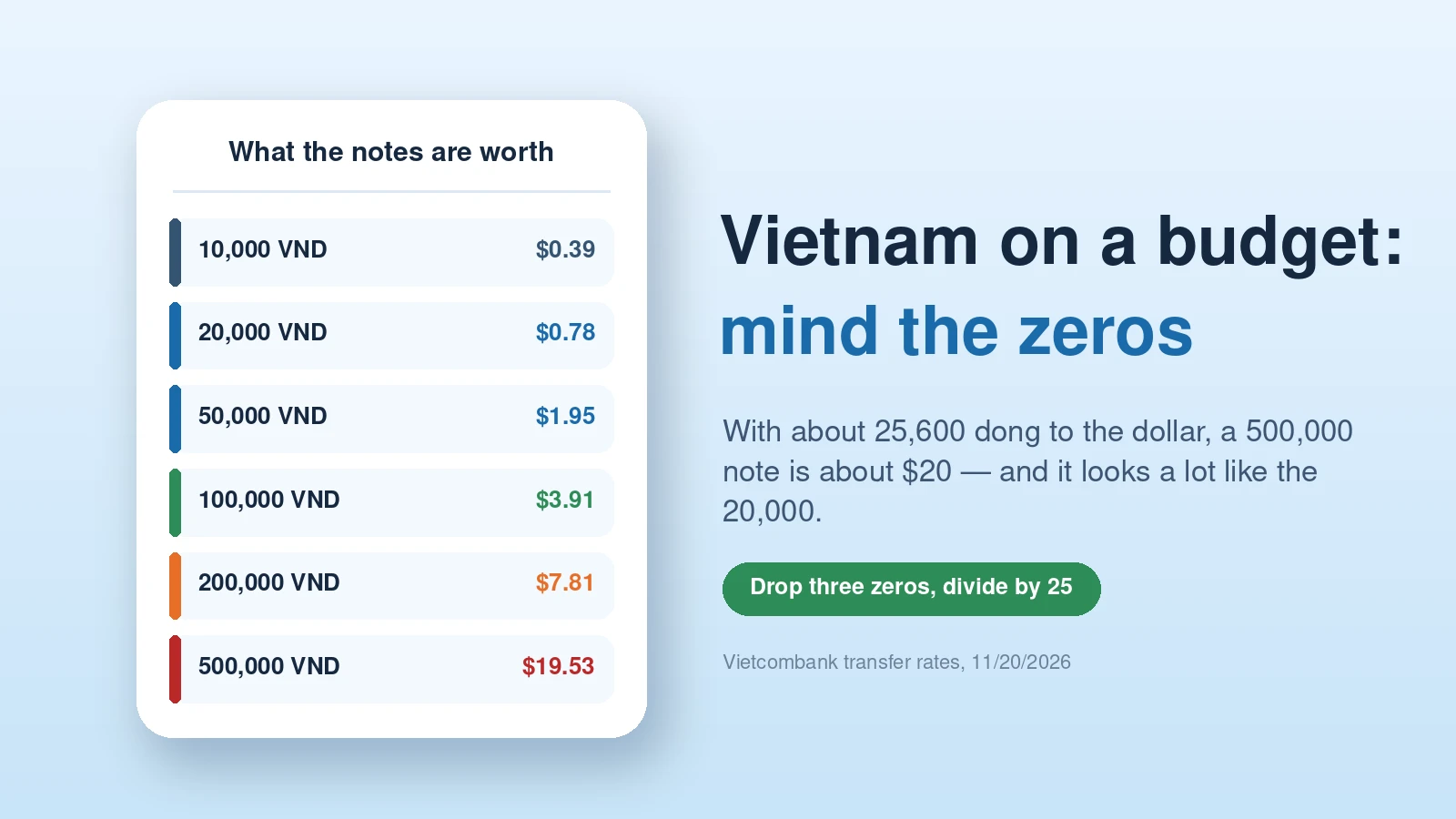
- Drop three zeros and divide by 25 for a quick dollar figure. 100,000 dong is about $4 (exactly $3.91).
- Check notes before you pay, especially the blue 20,000 and 500,000.
- Use cash for street food, markets and small shops. Cards work in hotels, malls and many restaurants in cities.
- Exchange at banks or reputable gold and jewellery shops in town rather than at the airport. Always count the money at the counter.
- Visitors can reclaim VAT on goods from participating shops: at least 2 million dong per shop per day, with 85% of the VAT refunded at the airport.
The dong and its zeros
The Vietnamese dong (VND, ₫) is the only legal currency for everyday payments. On 11/20/2026, Vietcombank’s transfer rate was 25,600 dong per US dollar and 27,861 per euro. Notes run from 1,000 to 500,000 dong. The higher values (10,000 and above) are made of polymer and look similar. The two most often confused are the 20,000 and 500,000 notes, which are both bluish. Handing over one for the other turns a $1 coffee into a $20 one.
- Sort your wallet by value and keep the 500,000 notes apart.
- Read the number, not the colour, when paying, and when counting your change.
- Prices are often shortened: “50k” or “50” on a menu means 50,000 dong.
Cash, cards and exchanging money
Cards (mainly Visa and Mastercard) work in hotels, malls, supermarkets, chain cafés and many city restaurants. Street food, markets, small shops, local buses and many taxis are cash only. Ride-hailing apps let you pay by card or in cash.
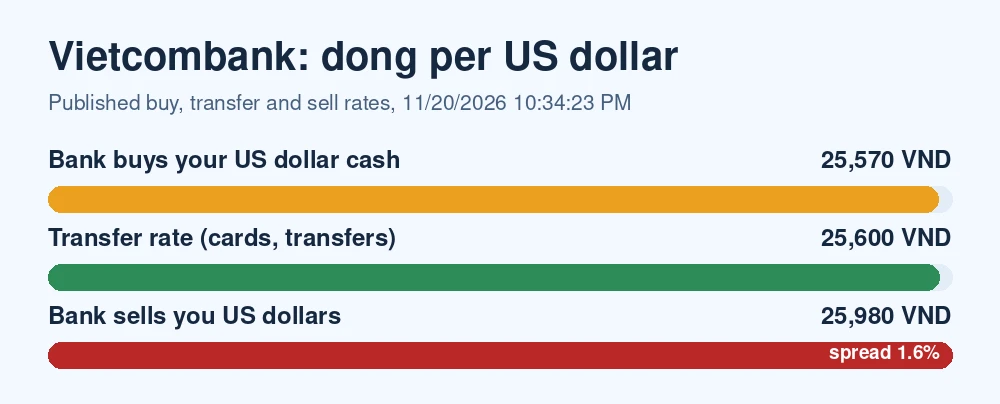
Banks publish separate rates for buying cash, for transfers and for selling. The gap between them is their margin. On 11/20/2026, Vietcombank bought US dollar cash at 25,570 dong and sold dollars at 25,980, a 1.6% spread:
Airport counters and hotels usually give less than banks. Bring clean, undamaged notes if you plan to exchange cash, because worn or marked notes may be refused or get a worse rate. At ATMs, expect a local fee per withdrawal on top of your own bank’s charges, and withdrawal limits that can be low. Always choose to be charged in dong, not your home currency.
Plan your budget
A trip budget is easier to stick to when you think in dong but check the total in your own currency. Put in your own prices for accommodation, food, transport and activities. The planner adds a buffer and converts the total:
Vietnam trip budget in your currency
The amounts are only an example — replace them with prices for your style of travel. Dong per unit of your currency: Vietcombank transfer rate for USD, EUR and GBP; ECB cross rates for others (11/20/2026). Runs in your browser.
Plan for the costs that are easy to forget, too. These include domestic flights or sleeper trains between regions, tours in Ha Long Bay or the Mekong Delta, visa fees, and a local SIM or eSIM. Our guide to shopping abroad covers bargaining and tourist prices.
Vietnam’s VAT refund for visitors
Foreign visitors can reclaim VAT on goods bought in Vietnam and taken out through an international airport or seaport. The rules were updated by Circular 84/2026/TT-BTC, which took effect on 1 July 2026, with an electronic procedure:
- Buy at a shop registered for VAT refunds and show your passport so it can issue the refund invoice electronically.
- Spend at least 2 million dong at one shop on one day. Several invoices from the same shop on the same day can be combined, but purchases from different shops or days cannot.
- Leave within 60 days of the invoice date, with the goods unused and in your luggage.
- Collect the refund at the airport (Hanoi, Ho Chi Minh City, Da Nang, Nha Trang and other international airports). The refund is 85% of the VAT on the invoice. The rest covers the service.
VAT is 8% on most goods until 31 December 2026 (a temporary cut from 10%; some categories stay at 10%). VAT is included in the price, so on 5 million dong of goods at 8% the VAT is about 370,370 dong, and you get back about 314,815 dong ($12.30).
Tipping and bargaining
Tipping is not traditionally expected, but it is increasingly common and appreciated in tourist areas. People often leave small change at restaurants, tip tour guides and drivers, and tip at spas. Bargaining is normal at markets and with street vendors, but not in supermarkets, malls or restaurants. Agree taxi and cyclo prices before you set off, or use an app with an upfront fare.
Currencies converts dong to your currency at the mid-market rate, so 350,000 on a price tag is never a guess. It works offline, which helps on overnight trains and boat trips with no signal.
Frequently asked questions
How much money do I need per day in Vietnam?
It depends on your travel style. Put your own prices for accommodation, food, transport and activities into the planner above, which adds a buffer and converts the total into your currency. Budget extra for domestic flights, tours and visas.
What is the easiest way to convert dong?
Drop three zeros and divide by 25 for a rough US dollar figure: 100,000 dong is about $4. At the Vietcombank transfer rate on 11/20/2026, it was exactly $3.91.
Should I use cash or card in Vietnam?
Both. Cards work in hotels, malls and many city restaurants. Street food, markets, small shops and many taxis take cash only. Choose to be charged in dong at ATMs and card terminals.
Can tourists get a VAT refund in Vietnam?
Yes. Under Circular 84/2026, in force since 1 July 2026, you need at least 2 million dong of purchases at one participating shop on one day. Leave within 60 days through an international airport or seaport. You receive 85% of the VAT on the invoice.
Which Vietnamese banknotes are easy to confuse?
The 20,000 and 500,000 dong notes are both bluish polymer notes. Check the number on every note when paying and when taking change.
Sources: Vietcombank published exchange rates, 11/20/2026 10:34:23 PM; Circular 84/2026/TT-BTC on VAT refunds for foreigners (effective 1 July 2026); Resolution 204/2025/QH15 (8% VAT rate until 31 December 2026).
Keep reading: How to shop abroad · Shopping in Thailand · Offline currency converter